

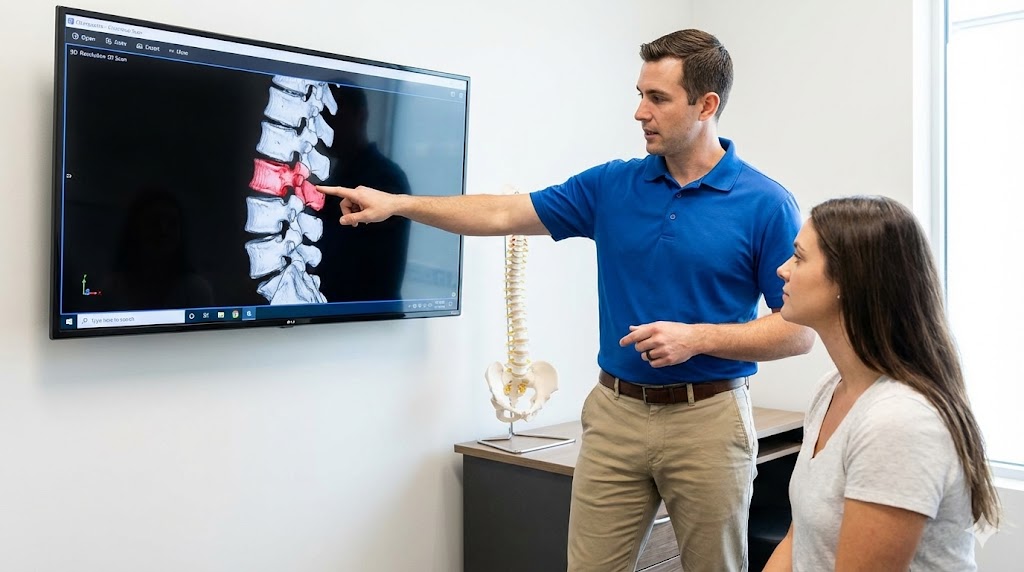
If you have ever visited a chiropractor, you have likely heard the term “subluxation.” But what exactly does it mean, and how does it impact your daily life?
At Advantage Chiropractic in New Berlin, we frequently treat patients who are suffering from the hidden effects of subluxations. Simply put, a joint subluxation is a partial dislocation. The bones that make up the joint are still partially touching, but they have shifted out of their proper, healthy alignment. This misalignment can create pressure, restrict your mobility, and interfere with your nervous system’s communication with the rest of your body.
Here is a clear breakdown of what causes subluxations, how to recognize the symptoms, and how we manage them safely and effectively.
Joint Subluxation Symptoms vs. Complete Dislocation
To understand a subluxation, it helps to know how it differs from a complete dislocation (luxation).
Complete Dislocation (Luxation): The bones in the joint are completely separated. This usually causes immediate, severe pain, visible deformity, and requires emergency medical attention to pop the joint back into place.
Subluxation (Partial Dislocation): The bones are only partially out of alignment. Because the joint hasn’t completely separated, the symptoms can be much more subtle. Some patients may not even realize they have a subluxation until the surrounding nerves become irritated.
Common Symptoms of a Subluxation
While the severity varies depending on the joint involved, common symptoms include:
Pain and Swelling: Discomfort ranging from a dull ache to sharp pain, often accompanied by localized inflammation.
Reduced Mobility: A stiff, restricted feeling that makes bending, twisting, or lifting difficult.
Nerve Interference (Numbness & Tingling): If the misaligned joint places pressure on a nearby nerve, you may feel a “pins and needles” sensation radiating into your arms or legs.
Joint Instability: A feeling that the joint might “give out” or lacks its usual strength.
Common Areas Affected by Subluxation
While a subluxation can technically happen in any joint, there are specific areas of the body that are highly susceptible:
Spinal (Vertebral) Subluxations: This is the most common issue we treat at Advantage Chiropractic. When the vertebrae in your spine lose their proper alignment due to poor posture, repetitive stress, or trauma, they can restrict spinal motion and interfere with the central nervous system.
Shoulder Subluxations: Often caused by sports injuries, repetitive overhead motions, or a sudden pulling force on the arm.
Patellar (Kneecap) Subluxations: Occurs when the kneecap shifts out of its natural groove, usually due to a direct impact or sudden twisting motion.
What Causes a Joint to Subluxate?
Subluxations don’t just happen out of nowhere. They are typically the result of physical stress placed on the body’s ligaments and joints. Common causes include:
Acute Trauma: Car accidents (whiplash), sports collisions, or slip-and-fall injuries.
Repetitive Strain: Performing the same physical motion repeatedly at work or during athletic training can gradually pull a joint out of alignment.
Poor Posture: Hours spent hunched over a desk or looking down at a phone can create chronic spinal subluxations, particularly in the neck (cervical spine).
Ligament Laxity: Some individuals naturally have hyper-flexible joints or experience looser ligaments during pregnancy, making them more prone to joint shifting.
How We Approach Subluxation Care
If a subluxation is left unaddressed, it can lead to chronic pain, accelerated joint wear and tear (osteoarthritis), and persistent nerve irritation.
At Advantage Chiropractic, our goal is to accurately identify and correct these misalignments so your body can function at its best.
1. Comprehensive Evaluation
Before any adjustments are made, we perform a thorough physical and neurological evaluation. By assessing your posture and range of motion, and using digital X-rays (when clinically necessary), we can pinpoint the exact location and severity of the subluxation.
2. Precise Chiropractic Adjustments
We specialize in the Torque Release Technique (TRT). Rather than traditional manual twisting or “cracking,” we use a specialized, FDA-cleared instrument called the Integrator to deliver a gentle, highly precise adjustment. This allows us to safely and comfortably correct spinal subluxations and reduce nerve interference.
3. Integrative Support
In addition to restoring proper alignment, we often incorporate soft-tissue therapies, targeted stretching, and ergonomic advice to help strengthen the muscles and ligaments around the joint and prevent future subluxations.
Proactive Prevention
While you cannot prevent every accident, you can protect your joints:
Maintain Proper Mechanics: Use safe lifting techniques and practice good ergonomics at your workstation.
Strengthen Supporting Muscles: Regular exercise that targets your core and joint-stabilizing muscles provides a stronger “scaffold” for your skeletal system.
Listen to Your Body: Don’t push through persistent joint pain or stiffness. Getting evaluated early can prevent a minor misalignment from becoming a chronic issue.
Find Relief in New Berlin, WI
You don’t have to live with the stiffness, nerve discomfort, or limited mobility caused by joint subluxations. Our clinical team is here to help you restore your alignment and get back to doing what you love.
Contact Advantage Chiropractic in New Berlin today to schedule your comprehensive evaluation.